


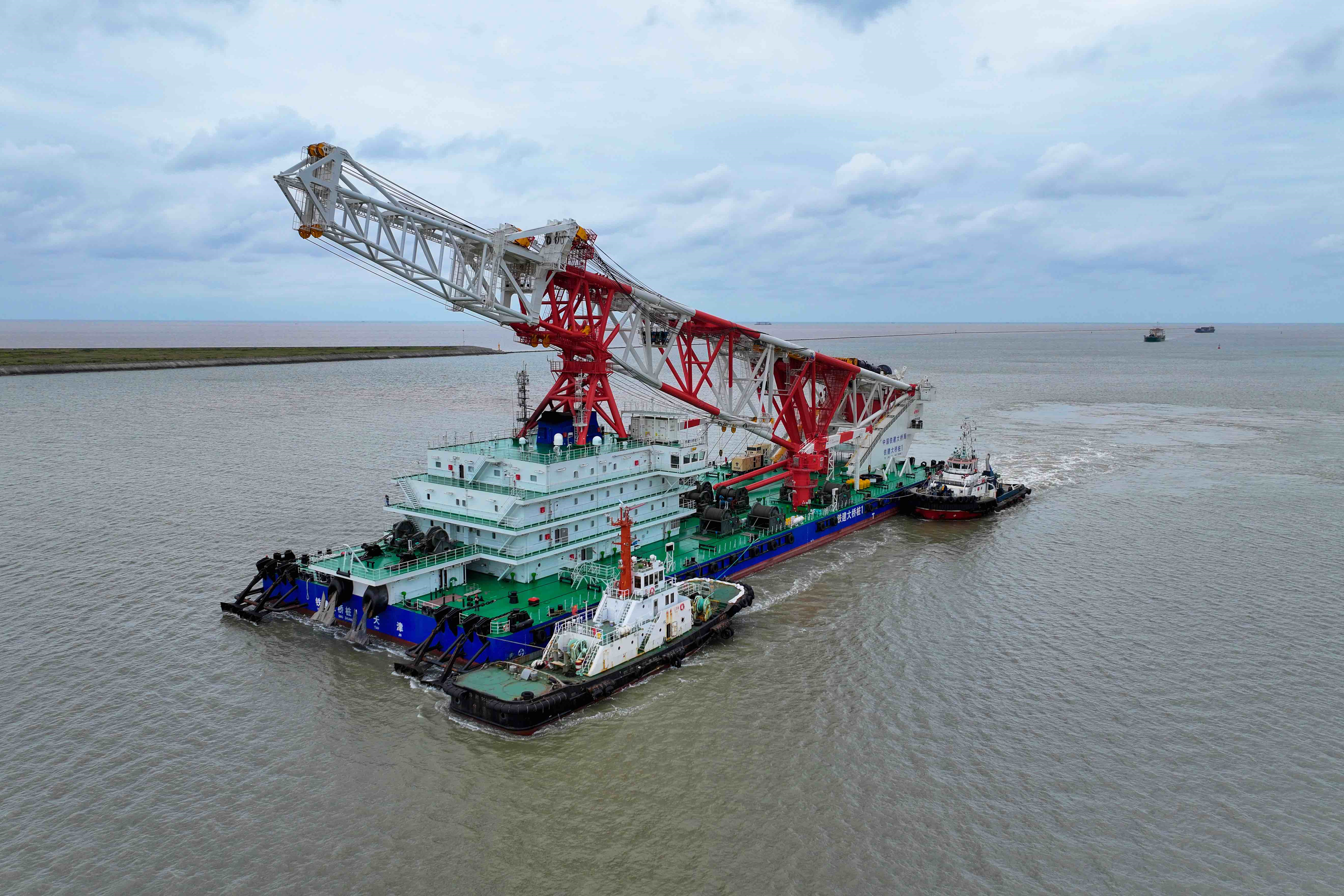
The "CRCC Bridge Pile 1" sets sail from Lüsi Port in Nantong City, east China's Jiangsu Province, Sept. 27, 2026. (Photo provided to Guangming Online)
BEIJING - The world's largest pile-driving vessel, "CRCC Bridge Pile 1," set sail from the foreign-trade wharf at Lüsi Port in Jiangsu Province, East China, on Sept. 27, bound for Todos os Santos Bay in Bahia State, Brazil.
Invested in and built by China Railway Construction Bridge Engineering Bureau Group, the vessel will join the construction of the Salvador-Itaparica Bridge, Latin America's largest sea-crossing cable-stayed bridge. Its deployment marks a new step in the global outreach of China's high-end marine engineering equipment as it moves into deeper and more distant waters.
Under the plan, the vessel will leave the Yangtze River Estuary, pass through the Strait of Malacca and the Cape of Good Hope, and enter the South Atlantic before arriving in waters off Recife on Brazil's northeastern coast. The 11,300-nautical-mile voyage is expected to take 45 days.
A Deep-Sea Pile-Driving Vessel
Built for deep and distant seas, the vessel features two world firsts technologically. It is the first large pile-driving vessel to integrate DP dynamic positioning with anchor positioning. Anchors cast from the four corners of the hull into the seabed hold the vessel in place, while the DP system senses wind, waves and currents in real time and uses bow and stern rudder propellers to generate counter-thrust and finely adjust the hull. Combined with China's domestically developed BeiDou high-precision satellite positioning system, this keeps pile-driving positioning accuracy at the centimeter level. The vessel is also the first pile-driving vessel to use a closed hydraulic system for its main cylinders. Designed and manufactured entirely in China, the system converts the potential energy generated when the pile frame descends or tilts forward into electricity for recovery, achieving an energy recovery rate of 40 percent. From design to core components, the vessel is independently developed and controllable.
With a length of 130.5 meters, a 156-meter pile frame and a pile-lifting capacity of 700 tonnes, the vessel can drive super-large piles 7 meters in diameter. Its operating water depth reaches 70 meters, and it leads the world in pile-frame height, pile-lifting capacity and operating water depth, helping overcome the bottlenecks that have long limited traditional pile-driving equipment in deep and distant seas and complex sea conditions -- insufficient reach, poor accuracy and unstable positioning.
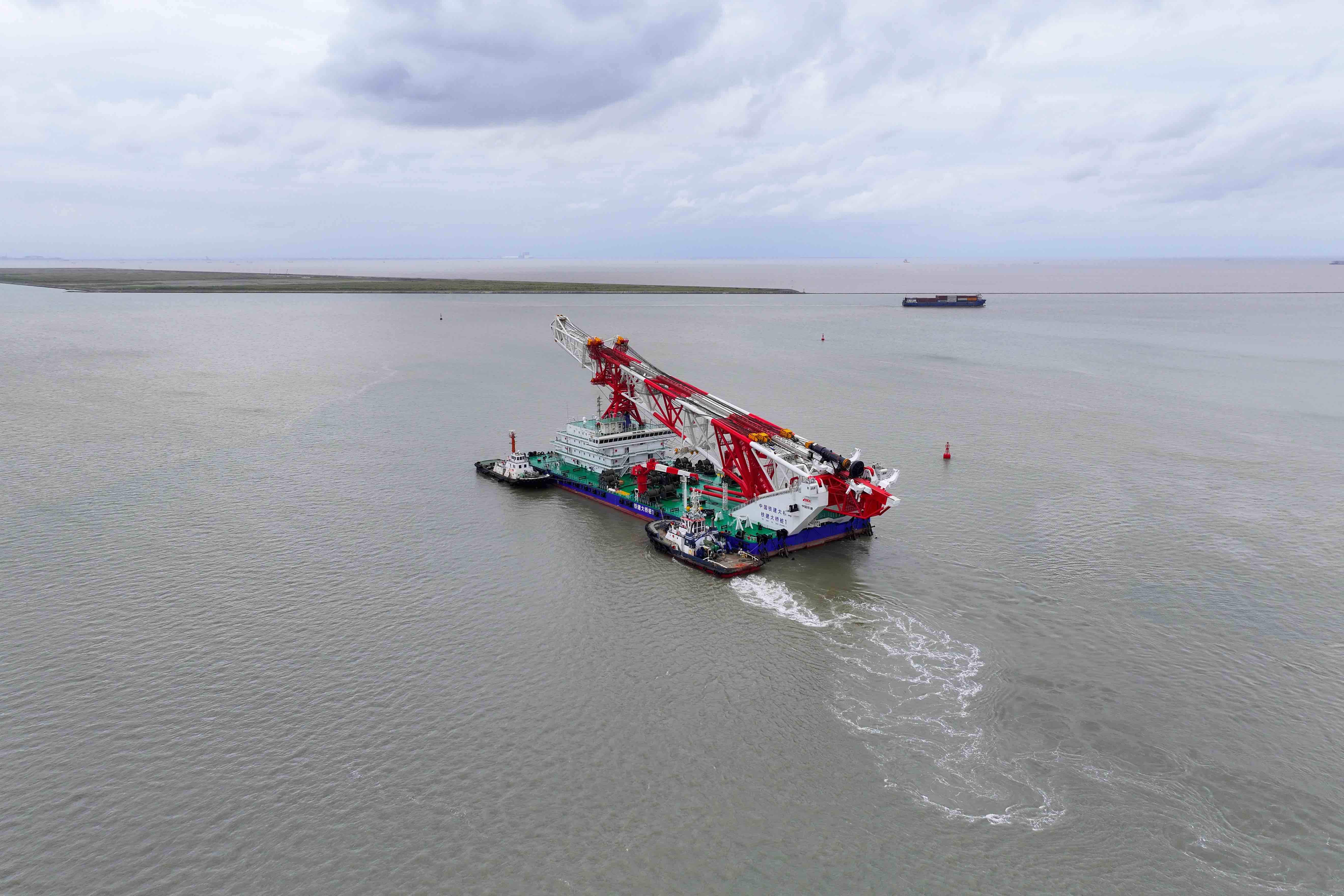
The "CRCC Bridge Pile 1" sets sail from Lüsi Port in Nantong City, east China's Jiangsu Province, Sept. 27, 2026. (Photo provided to Guangming Online)
A Landmark Sea-Crossing Bridge
Stretching across Todos os Santos Bay, Brazil's largest bay, the Salvador-Itaparica Bridge will have the deepest pile foundations of any sea-crossing bridge in the world. Water depth at the main bridge's pile foundation construction site reaches 64 meters, and marine geological conditions are complex.
The bridge is invested in, built and operated by a concession company jointly established by four shareholders, including China Civil Engineering Construction Corporation under China Railway Construction Corporation. It has a main span of 682 meters and a total length of 46.8 kilometers. Once completed and open to traffic, it will cut travel time between Salvador and Vera Cruz from one hour by ferry to about 15 minutes, and shorten by 200 kilometers the transport distance for grain, cotton, fruit and other goods produced in western Bahia.
In recent years, China's pile-driving vessel technology has shifted from catching up to leading, and Chinese marine engineering equipment is expected to take on more roles in global offshore engineering construction.
点击右上角 微信好友
微信好友
 朋友圈
朋友圈

请使用浏览器分享功能进行分享