


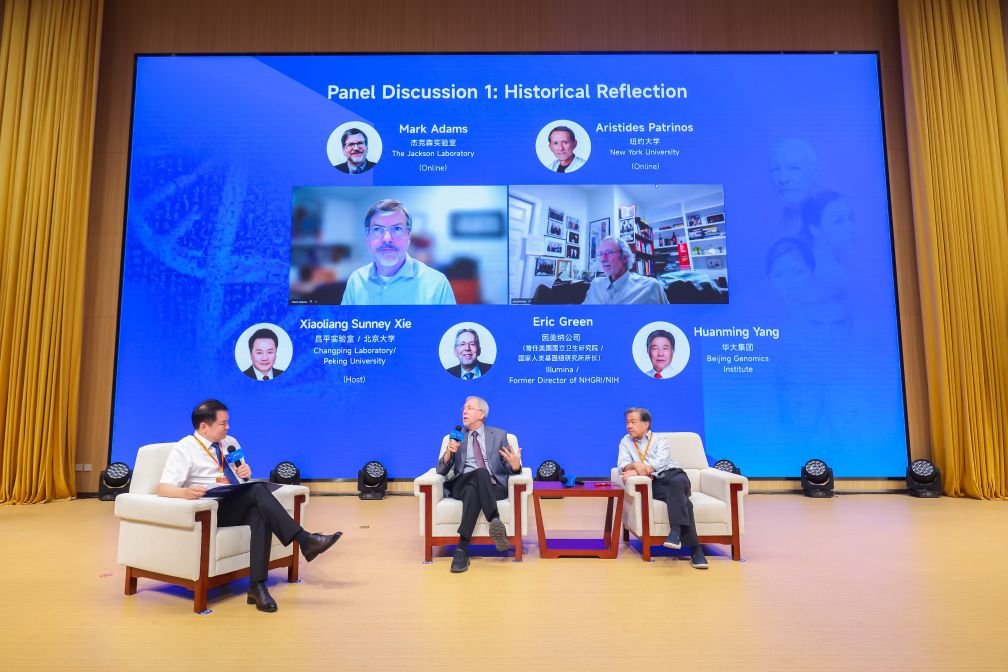
Guests attend a panel discussion at an international symposium held to commemorate the 25th anniversary of the Human Genome Project's landmark release of the draft human-genome sequence, in Beijing, capital of China, Aug. 24, 2026. (Changping Laboratory/Handout via Xinhua)
BEIJING, Aug. 27 (Xinhua) -- Fueled by major breakthroughs in genome sequencing over the past 25 years, Chinese scientists have achieved sustained innovation across the country's biomedical sector.
China's achievements were highlighted early this week at an international symposium held in Beijing to commemorate the 25th anniversary of the Human Genome Project's landmark release of the draft human-genome sequence.
The two-day symposium, hosted by the Beijing-based Changping Laboratory, attracted more than 30 top scientists and over 100 experts and scholars from countries including China, the United States, Britain and Sweden.
Xie Xiaoliang, an academician of the Chinese Academy of Sciences (CAS) and director of Changping Laboratory, said in his speech that "the Human Genome Project is a milestone in life sciences in the 21st century, driving progress across almost all fields of biology and medicine, including molecular biology, cell biology, neuroscience and pharmacology."
Yang Huanming, also a CAS academician and China's lead for the Human Genome Project, noted that China officially joined the project in 1999. Chinese scientists have contributed 1 percent of sequencing work and submitted roughly 1.3 percent of raw data, contributing much to the genomics era through innovative studies.
Based on gene sequencing technologies, Chinese scientists have achieved clinical applications translated from basic research, making remarkable contributions in birth defect prevention and population genetic cohort studies.
The outcomes include the world's first test-tube baby screened for monogenic genetic disorders, non-invasive prenatal testing (NIPT), and genomic research within the China Kadoorie Biobank, one of the world's largest prospective cohort studies aiming to generate reliable evidence about the lifestyle, environmental and genetic determinants of a wide range of common diseases.
The Human Genome Project has opened a window for identifying cell-free DNA in plasma, which leads to the development of NIPT and provides a vital solution for maternal prenatal screening worldwide, said Dennis Lo Yuk-ming, a CAS academician and vice-chancellor and president of the Chinese University of Hong Kong.
Over two decades ago, his team discovered that in pregnant women's blood, in addition to their own DNA, there was a small portion of cell-free DNA originating from the fetus. Through high-throughput sequencing and bioinformatics analysis, the fetal DNA could be accurately detected, sequenced and analyzed to determine if there were chromosomal abnormalities and other genetic disorders.
This method boasts higher accuracy than traditional prenatal screening methods and is even comparable to invasive prenatal diagnosis. Pregnant women only need a routine blood draw without experiencing high-risk procedures. The method has been adopted in various regions around the world and has served over 100 million pregnant women.
After the NIPT, his team extended this technology to non-invasive early cancer detection. They developed a series of products based on next-generation and high-throughput sequencing technology, targeting common cancers such as lung, liver and breast cancer. These products not only offer high sensitivity and specificity, but are also easy to operate on a large scale.
Now, his team continues to deepen the clinical application of this technology in cancer and other major diseases. One area of focus is the emerging field of cell-free DNA fragmentomics, where researchers have discovered that fragments of cell-free DNA can provide important diagnostic clues for diseases like cancer.
Other scientists attending the symposium also highlighted the rapid development of sequencing technologies inspired by the Human Genome Project.
Xu Xun, chief researcher of biotech company BGI Group, said that through technological progress, the cost of gene sequencing has gradually decreased. Starting from 8,000 U.S. dollars, it dropped to 1,000 dollars, and now is as low as 100 dollars.
He further noted that in recent years, new targeted cancer therapies have been emerging, and that their development is directly linked to gene sequencing, through which new therapies can identify targets. Therefore, gene sequencing technology is a crucial foundational tool for targeted cancer therapies.
"We hope to carry forward the scientific spirit of the Human Genome Project, deepen international research collaborations, and link the chain from basic research and technological innovation to clinical translation in areas such as aging-related diseases, cancer and neurodegenerative diseases," Xie Xiaoliang said.
点击右上角 微信好友
微信好友
 朋友圈
朋友圈

请使用浏览器分享功能进行分享