


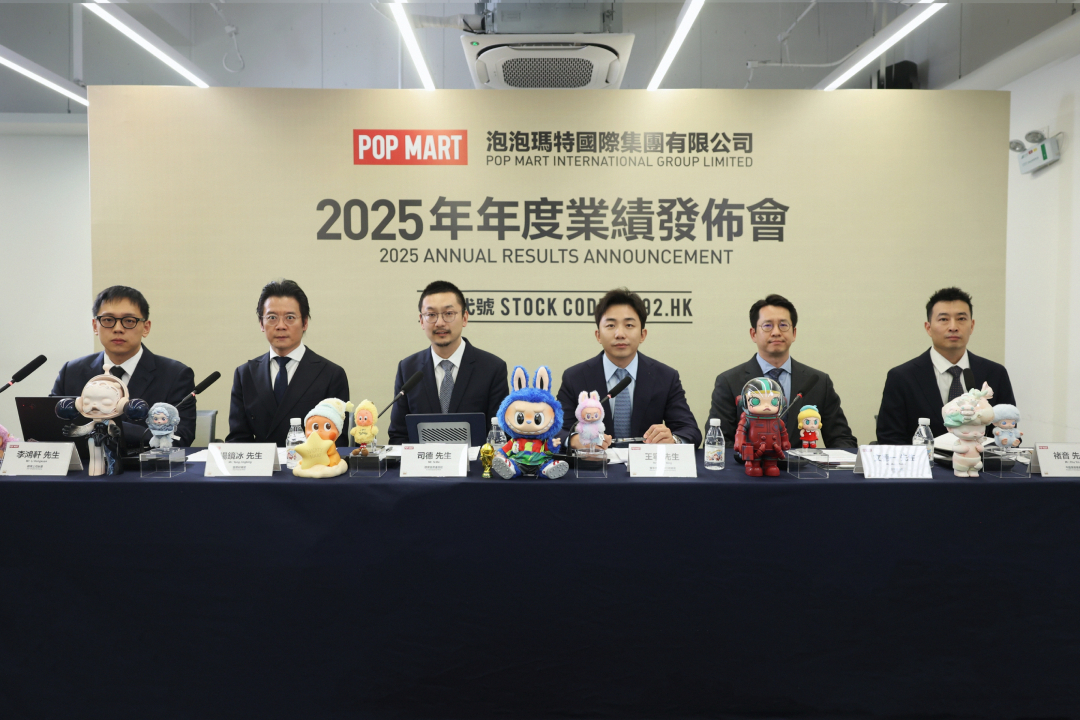
Pop Mart holds its 2025 Annual Results Announcement in Beijing on March 25, 2026. (Photo provided to Guangming Online)
BEIJING — At an earnings briefing in Beijing on Wednesday, Pop Mart Chairman and CEO Wang Ning said the company achieved rapid growth in both scale and revenue, with its brand and intellectual property (IP) influence reaching a record high.
Pop Mart's revenue reached 37.12 billion yuan ($5.1 billion) in 2025, up 184.7% year on year. Adjusted net profit rose 284.5% to 13.08 billion yuan ($1.8 billion), according to company data.
The company's performance reflects China's broader push toward consumption-driven growth, creative industries and globally competitive brands.
Global footprint grows rapidly
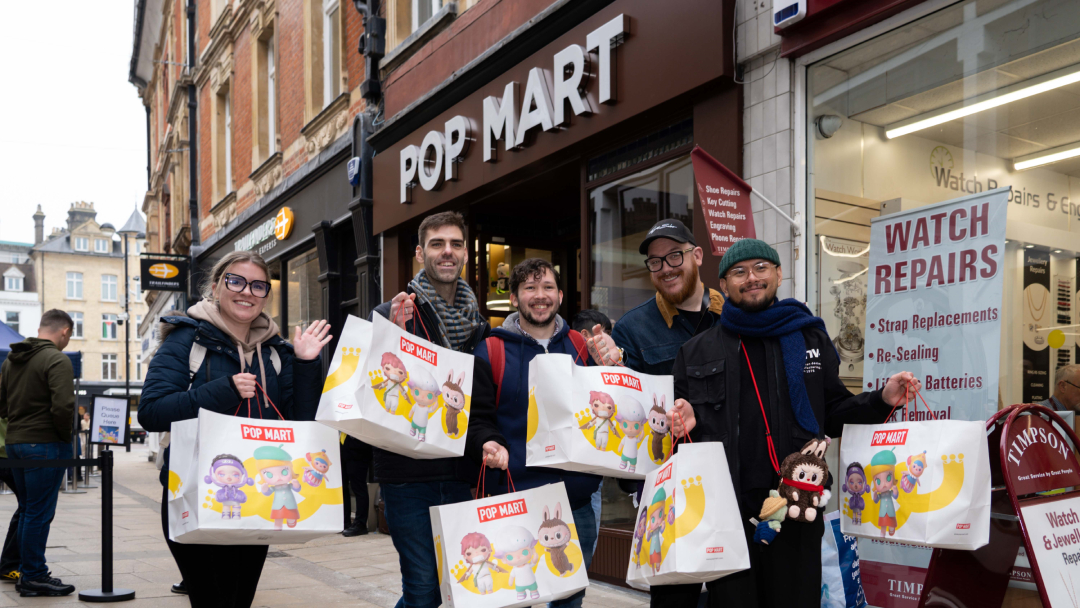
Customers purchase products at Pop Mart's Cambridge store in the UK. (Photo provided to Guangming Online)
By the end of 2025, Pop Mart operated 630 retail stores and 2,637 vending machines across 20 countries and regions. During the year, the company entered new markets including Denmark, Germany, the Philippines and Canada, expanding into more than 30 cities like Berlin, Rome, Copenhagen and Toronto.
While China remains its largest market, overseas business is becoming an increasingly important growth driver, accounting for 43.8% of total revenue. The Asia-Pacific region outside China generated 8.01 billion yuan ($1.1 billion), up 157.6%, while the Americas market surged 748.4% to 6.81 billion yuan ($940 million).
Pop Mart said North America remains a key growth area, with 72 stores currently in operation and more than 100 expected by the end of 2026. Flagship stores in New York's Times Square and Fifth Avenue are scheduled to open in the fourth quarter.
The company has established offices in 20 countries and regions and currently employs more than 11,000 people worldwide, including nearly 4,000 non-Chinese staff.
It has also strengthened its global supply chain, with six production bases now operational. New partner factories in Indonesia, Cambodia and Mexico began shipping in January 2026.
IP-driven business model
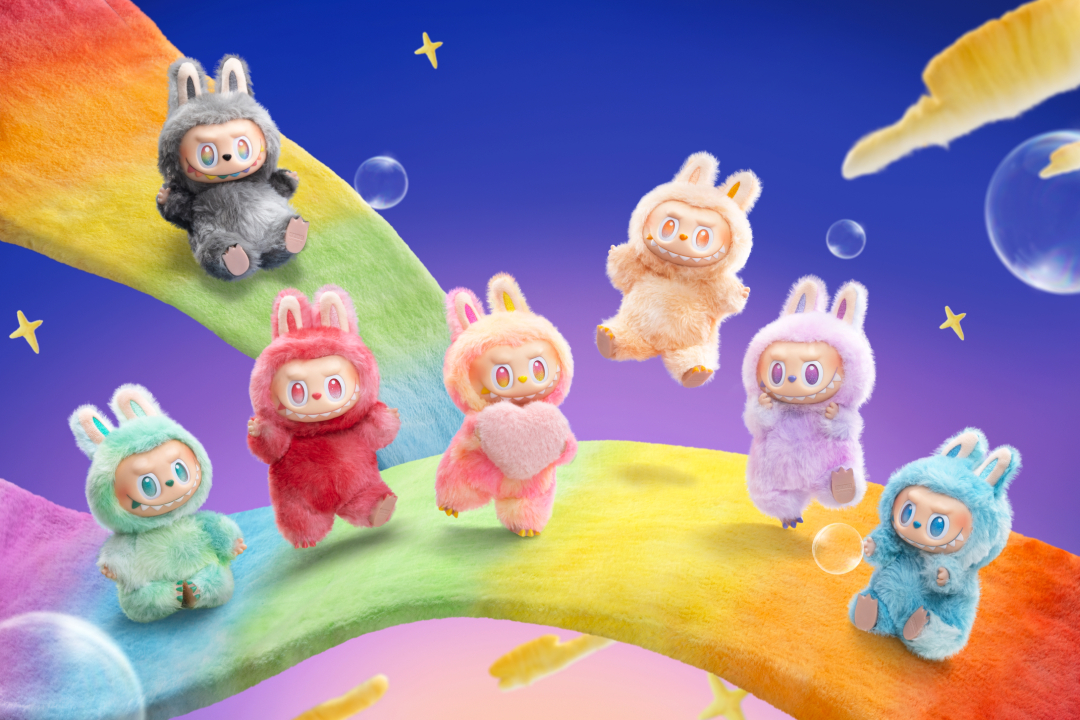
Pop Mart's THE MONSTERS "Big into Energy" series is on display. (Photo provided to Guangming Online)
Pop Mart's growth has been fueled by its portfolio of designer toy characters, a business model that combines art, entertainment and retail.
Its top IP, THE MONSTERS, generated 14.16 billion yuan ($1.95 billion) in revenue, up 365.7%. The character LABUBU gained global popularity in 2025, supported by celebrity exposure and cross-industry collaborations.
The company is further expanding LABUBU's commercial reach, announcing a partnership tied to the FIFA World Cup, alongside new product launches and artist collaborations. A film project based on the character, developed with Sony Pictures, is currently in the scripting stage.
Other major IPs also performed strongly, including SKULLPANDA, CRYBABY, MOLLY and DIMOO, each generating more than 2 billion yuan in revenue, at 3.54 billion yuan ($490 million), 2.93 billion yuan ($400 million), 2.90 billion yuan ($400 million) and 2.76 billion yuan ($380 million), respectively.
Plush toys became the company's largest product category for the first time, with revenue reaching 18.71 billion yuan ($2.6 billion), up 560.6%. Pop Mart is also exploring new business lines, including jewelry stores and dessert retail concepts.
Domestic strength supports global reach
China remained Pop Mart's largest market, accounting for 56.2% of total revenue. Domestic sales rose 134.6% to 20.85 billion yuan ($2.9 billion) despite a high base.
The company's membership ecosystem continued to expand, with 72.58 million registered members in Chinese mainland by the end of 2025. Annual additions reached 26.5 million, and the repurchase rate stood at 55.7%.
Pop Mart's performance highlights the growing role of cultural and creative industries in China's economic model. By exporting IP-based products and retail formats, companies like Pop Mart are not only generating revenue but also shaping global consumer trends.
Wang said Pop Mart aims to maintain growth of no less than 20% in 2026, focusing on sustainable and profitable growth rather than aggressive, short-term gains. "Our goal remains long-term, stable and healthy growth," he said.
点击右上角 微信好友
微信好友
 朋友圈
朋友圈

请使用浏览器分享功能进行分享