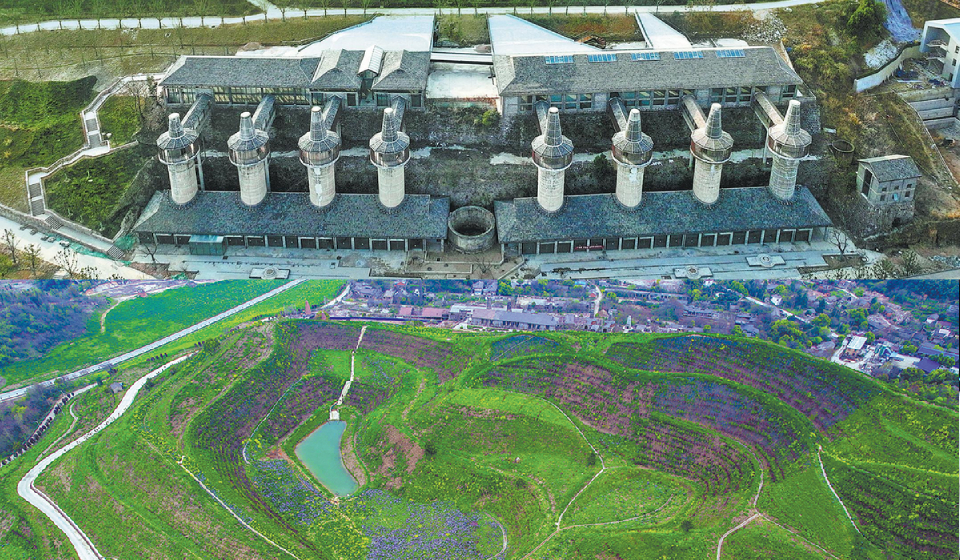


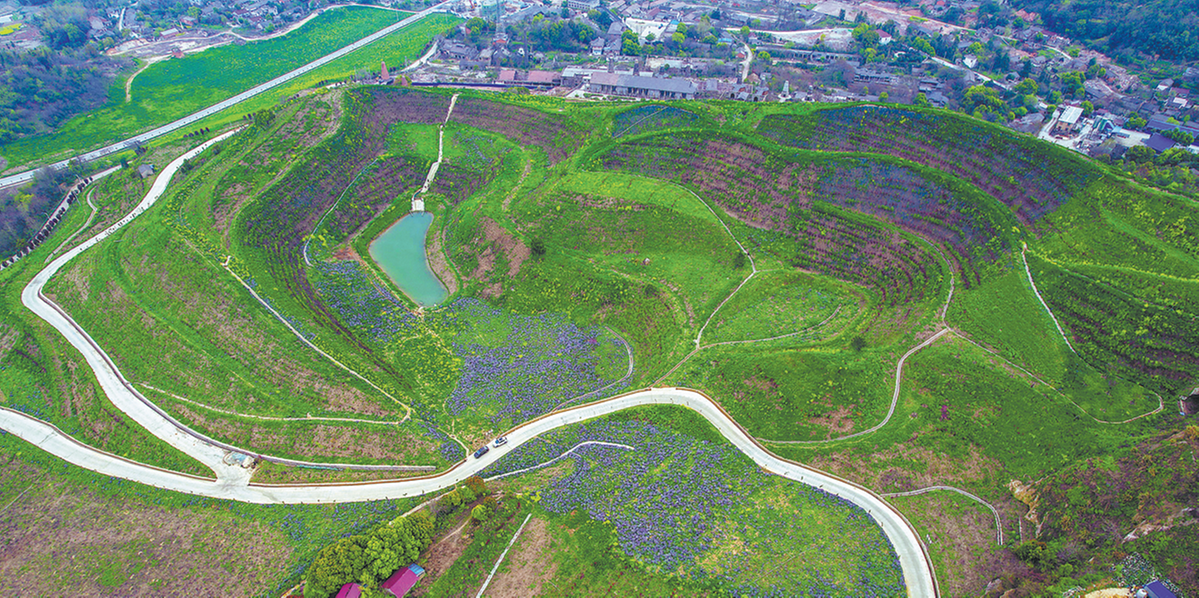
Vegetation covered the alum mine industrial heritage park in Fanshan town of Lujiang, Anhui province, in July 2023. (Li Hongbing/Xinhua)
As protection of the planet's flora, fauna and resources becomes increasingly important, China Daily is publishing a series of stories to illustrate the country's commitment to safeguarding the natural world.
After retiring, Hong Zengyi often returns to the alum mine in Hefei, the capital of East China's Anhui province, where he once worked.
A road divides the former mine area into two parts. On one side is the old mine's preserved residential area, and on the other is a tourist attraction being renovated from the old factory buildings, mostly built in the 1960s.
These structures are located at the foot of the hills. Nowadays, these hills are covered with green vegetation, with only a small, exposed hilltop left in its original, almost barren state.
This deliberately preserved area serves as a reminder of what this mountainous region once looked like.
Bustling epoch
This is Fanshan township in Lujiang county, governed by Hefei.
Fanshan, literally meaning "alum hill", has been one of China's most important alum-producing areas since the early eighth century in the Tang Dynasty (618-907).
Alum is a chemical compound, typically potassium aluminum sulfate, used in water purification and textile dyeing. Historically, alum was an important industrial material due to its versatile applications.
After the founding of New China, the Lujiang alum mine became one of the country's 18 key chemical mines. Its products were sold in dozens of countries and regions, including Singapore, Japan, Malaysia, and New Zealand.
Hong, born in 1961, joined his parents at the mine in 1981.
"At that time, the mine was like a small city," said Hong.
There were schools for children, a workers' hospital, a lighted sports field, and a thousand-seat auditorium. The weekly "Workers' Movie Day" was a festival for the mining area and surrounding villages.
"As the screen was drawn, the laughter of thousands resonated in unison. We were proud to say we were from the Lujiang alum mine," said Hong.
But in Hong's memory, there were no forests here.
"When I worked at the mine, I came home every day with black nostrils, and the collar of my white shirt would be covered with a layer of dust in half a day," he said.
With social progress and technological development, alum was gradually replaced by a range of new chemical products, leading to the decline of the alum mining industry.
In May 2001, the Lujiang alum mine ceased production, marking the end of a 1,300-year mining history.
"This was a market decision, not a human one," said Hong. Although he misses the years he worked there, he does not regret the closure of the alum mine. In 2002, although Hong was already one of the mine's managers, he, like all employees, was laid off in search of a new livelihood.
In 2014, the alum mine officially declared bankruptcy. In December 2020, the Lujiang alum mine was selected as one of the "Fourth Batch of National Industrial Heritage" sites.
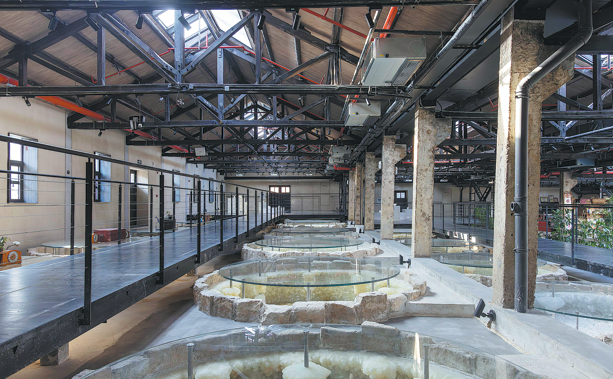
Crystallization ponds at the alum mine have been turned into a tourist attraction at the park. (Fang Yan/For China Daily)
Silent pollution
After the mine was shut down, people left, the bustling days ended, leaving only barren mountains and memories slowly eroding over time.
"In the following 20 years, this abandoned mine posed significant ecological challenges," said Hu Zhiwei, chief planner of Lujiang's natural resources and planning bureau.
The official showed the monitoring data before treatment: the pH value of the acidic wastewater from the mining area was as low as 2.0, comparable to vinegar.
It was rich in heavy metals such as iron, aluminum, and manganese, continuously seeping from mine pits and waste residue, flowing into rivers, and eventually reaching Chaohu Lake and the Yangtze River, according to Hu.
Chaohu is China's fifth-largest freshwater lake and an important ecological barrier for Hefei. The alum mine is located in a sensitive area upstream of this lifeline.
"At that time, the county had obvious deficiencies in funding and technology," said Hu.
In 2021, an adaptive experiment quietly started at the edge of a mine pit considered an "ecological dead zone".
"When we first arrived, this area was basically barren," said Jia Zenghua, an engineer responsible for the following restoration project.
Start of restoration
In February 2021, the Ministry of Finance, the Ministry of Natural Resources, and the Ministry of Ecology and Environment jointly issued a notice, organizing local governments to apply for central financial support for the "Mountain-River Projects".
Such projects aimed at integrated protection and restoration of mountains, rivers, forests, fields, lakes, grasslands and sand.
The Anhui Chaohu Lake Watershed Integrated Protection and Restoration Project thus became one of the first batch of such projects for the 14th Five-Year Plan period (2021-25).
"Lujiang keenly saw this significant opportunity to restore the abandoned alum mine," said Hu.
In May 2021, Hefei began investing 15.1 billion yuan ($216 million) to package relevant projects, including alum mine treatment, into an overall plan to protect the Chaohu Lake watershed.
It was successfully listed as a national project, receiving 2 billion yuan in central financial support. The Lujiang county government actively secured 20 sub-projects, obtaining 7.4 billion yuan in investment, including 980 million yuan in central funds.
As one of the sub-projects, the alum mine treatment project alone received 160 million yuan in central financial support.
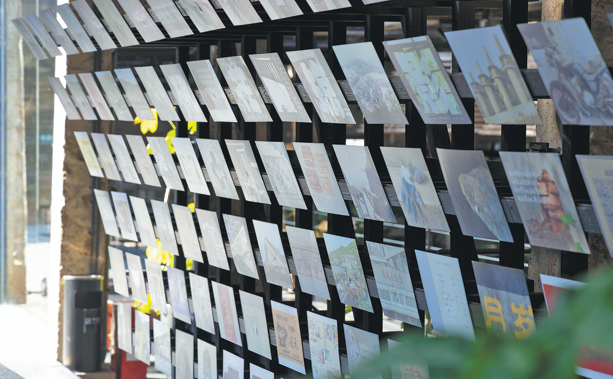
Photos showcasing the mine's past are on display at the park. (Fang Yan/For China Daily)
Major operations
Engineers said the alum mine's treatment required three transformative "surgeries".
To restore the surface of the hills, the traditional approach was to cover the area with new soil from elsewhere, but the demand for new soil was too great, and it could not solve the pollution problem, said Jia.
Therefore, the project team chose the most advanced "in-situ substrate improvement technology".
"For the entire alum mine treatment, we didn't bring in a single truckload of soil from outside," said Jia.
The technical team added self-developed neutralizers, soil improvement substrates, and microbial agents to the native mine slag and acidic soil, fundamentally changing the soil's "physique" to meet the standards suitable for plant survival.
"This avoids the situation of curing one area while damaging another, truly achieving both root and branch treatment," said Jia.
For the nearly vertical open-pit mine walls, the team used ecological long bags: workers hung safety ropes, anchored long strip-shaped eco-friendly bags filled with improved substrate to the rock walls, and planted grass seeds and shrub seedlings.
With the help of an intelligent drip irrigation system, they achieved a 99 percent vegetation coverage rate on the sheer cliffs.
To block the outflow of acidic water during the treatment period, the team built an 8-kilometer-long drainage ditch at the bottom of the mine to intercept rainwater that had collected on the mountain and further treat it.
They used microbial mineralization anti-seepage technology to seal underground cracks, preventing acidic sewage from continuing to seep underground.
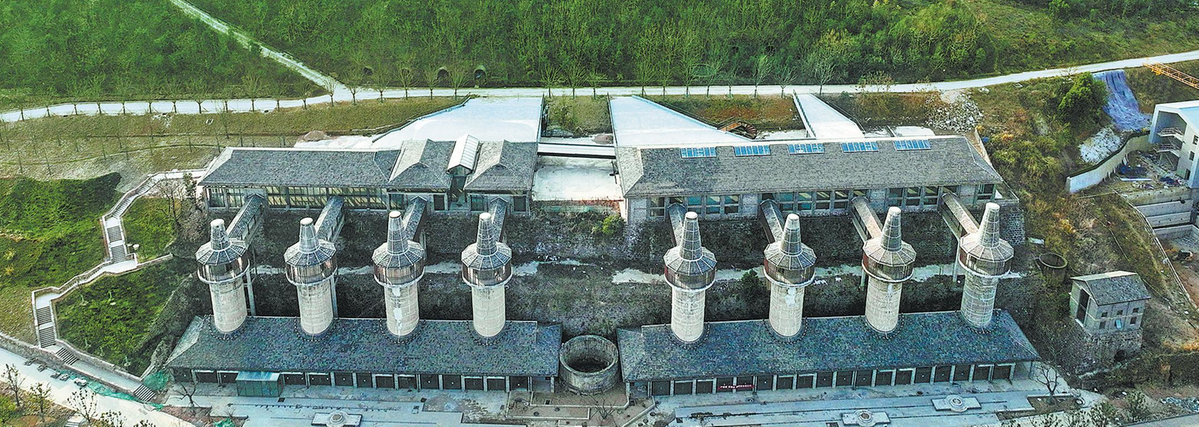
Eight kilns that were once used for roasting alum ore remain as iconic structures in the industrial heritage park. (Wang Hao/For China Daily)
New prosperity
"After years of efforts, now there are more than a dozen plant species that have improved the living environment through the four seasons, paving the way for more life to arrive," said Zhang Chuyi, who represented the designer of the restoration, Northwest Engineering Corporation, under Power Construction Corporation of China.
"Snakes, lizards, hedgehogs, and various birds have quietly returned," she said.
As ecological restoration progressed, the local state-owned companies also invested 2.5 billion yuan in 2021 to develop the former mine buildings into a tourist attraction.
The developers called the new site Fanhuayuan and gave it an English name, Fan Find Fun.
In December 2024, the Lujiang alum mine relics and their cultural landscape were included on the tentative list of the world cultural heritage.
"Protection is not about sealing it away but allowing memories to continue breathing in a new spacetime," said Hu Bin, manager of Anhui Fanshan Cultural Tourism Investment and Operation Co.
They invited cultural and historical experts and former miners to document the 1,300-year mining history and organize old photos, tools and production logs.
This tourism complex project is expected to be completed this year, with the goal of accommodating 3 million tourists annually, generating a revenue of 270 million yuan, and creating over 1,000 jobs, according to Hu.
"We left a small, unrepaired barren mountain on purpose, so future generations know that with persistent efforts, barren mountains can become green mountains and clear waters," said Deng Qingyong, a member of Fanshan town's Party committee.
"We also want to keep this historical scar so that future generations do not forget the pain after healing the scar. If we excessively exploit nature, all that will be left is heavy pain," said Deng.
By Zhu Lixin. Liu Chang contributed to this story.
点击右上角 微信好友
微信好友
 朋友圈
朋友圈

请使用浏览器分享功能进行分享