

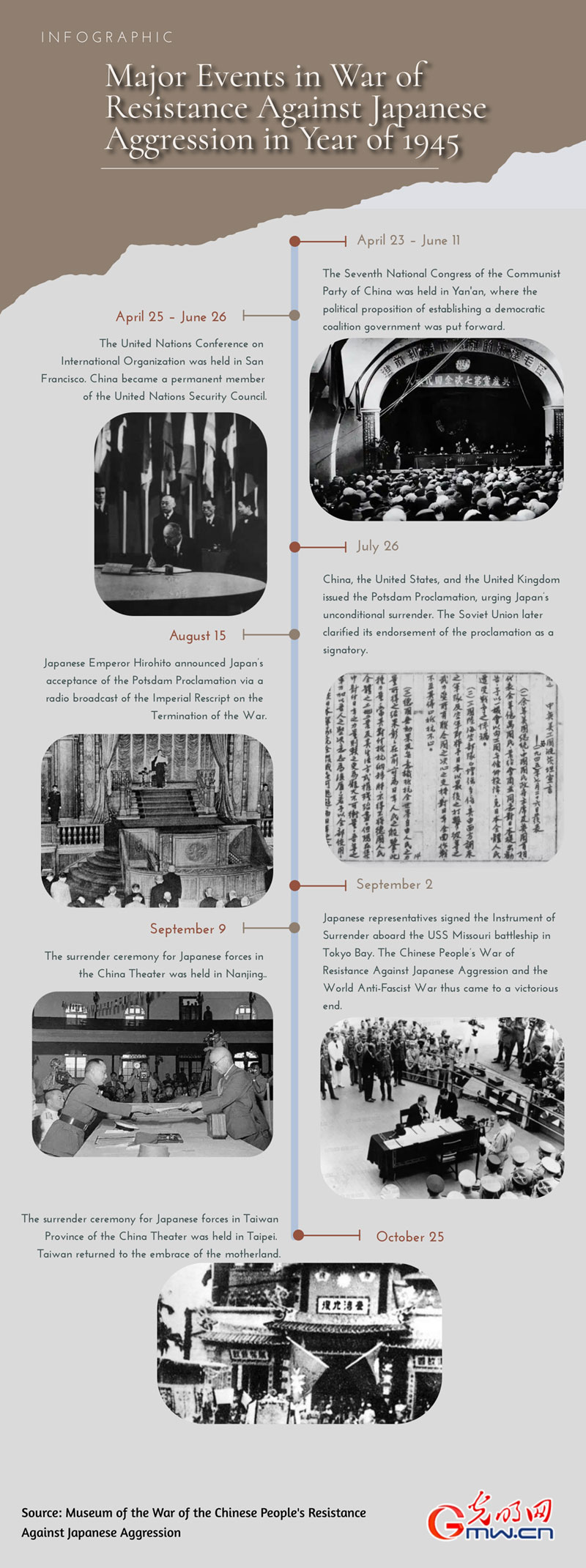
From April 23 to June 11, 1945, the Seventh National Congress of the Communist Party of China was held in Yan'an, where the political proposition of establishing a democratic coalition government was put forward.
From April 25 to June 26, 1945, the United Nations Conference on International Organization was held in San Francisco. China became a permanent member of the United Nations Security Council.
On July 26, 1945, China, the United States, and the United Kingdom issued the Potsdam Proclamation, urging Japan’s unconditional surrender. The Soviet Union later clarified its endorsement of the proclamation as a signatory.
On August 15, 1945, Japanese Emperor Hirohito announced Japan’s acceptance of the Potsdam Proclamation via a radio broadcast of the Imperial Rescript on the Termination of the War.
On September 2, 1945, Japanese representatives signed the Instrument of Surrender aboard the USS Missouri battleship in Tokyo Bay. The Chinese People’s War of Resistance Against Japanese Aggression and the World Anti-Fascist War thus came to a victorious end.
On September 9, 1945, the surrender ceremony for Japanese forces in the China Theater was held in Nanjing.
On October 25, 1945, the surrender ceremony for Japanese forces in Taiwan Province of the China Theater was held in Taipei. Taiwan returned to the embrace of the motherland.
点击右上角 微信好友
微信好友
 朋友圈
朋友圈

请使用浏览器分享功能进行分享