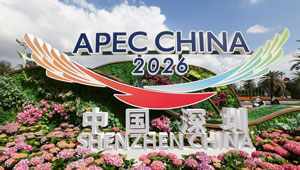


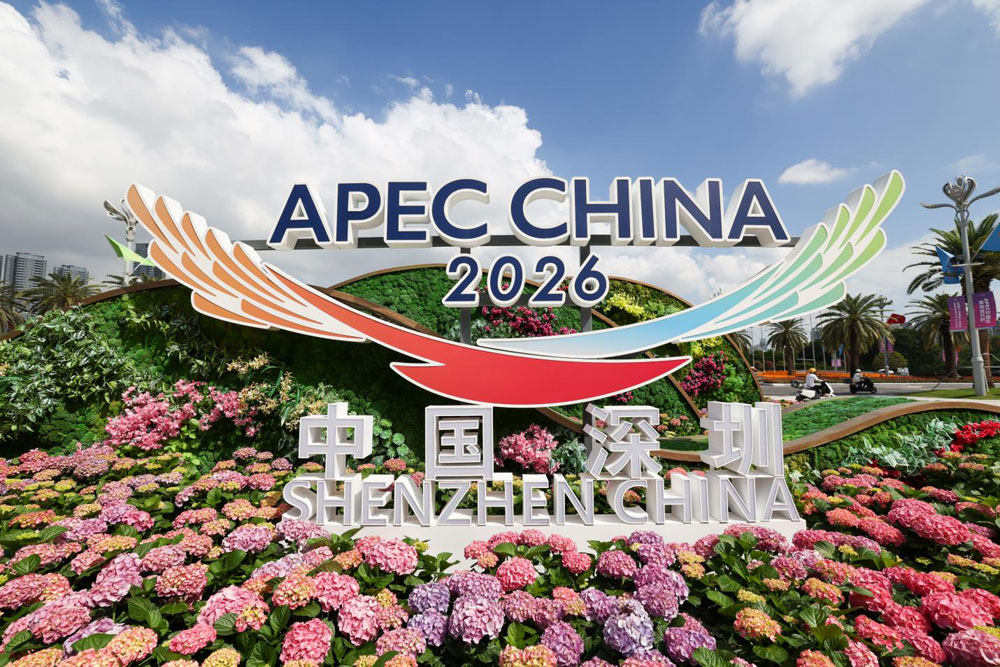
Photo taken on Nov. 5, 2026 shows the "Pengxiang Bilang" (Roc Soaring Over Blue Waves) themed landscape at the Qianhai Exhibition Hall Square in Shenzhen, south China's Guangdong Province. (Xinhua/Liang Xu)
By Light Blade
On November 18, the 33rd Asia-Pacific Economic Cooperation (APEC) Economic Leaders' Meeting will convene in Shenzhen, China. As the pioneering window of China's reform and opening-up and a global hub of technological innovation, this vibrant coastal metropolis is welcoming the Asia-Pacific family at a pivotal historical juncture. Convening under the theme of "Building an Asia-Pacific Community to Prosper Together" and focusing on the three priorities of openness, innovation, and cooperation, this gathering will not only inject fresh momentum into the region’s long-term development, but also send a clear message of solidarity to a world navigating profound turbulence and transformation.
Mapping Out a Clear Blueprint in Step with the Times
Since its inception, APEC's evolution has been closely intertwined with the broader tides of economic globalization and regional integration. In the late 1980s, as Cold War tensions waned and international relations shifted steadily toward economic development, APEC was established in 1989 as the premier economic forum in the Asia-Pacific—featuring the highest level of participation, the broadest scope, and the strongest influence in the region. The 1991 Seoul APEC Declaration formally enshrined its core objectives: recognizing economic interdependence, advancing common interests, upholding an open multilateral trading system, and reducing regional trade barriers. Over the past three decades, guided by the unique "APEC Way" of voluntary participation, consensus-building, and open regionalism, member economies have transcended differences in history, culture, social systems, and development stages to create the world-renowned "Asia-Pacific Miracle."
Entering a new era, APEC continues to follow a clear medium- and long-term roadmap. Following the conclusion of the Bogor Goals, which set landmark timetables for free and open trade and investment, leaders endorsed the APEC Putrajaya Vision 2040. This forward-looking blueprint envisions "an open, dynamic, resilient and peaceful Asia-Pacific community by 2040, for the prosperity of all our people and future generations." It identifies three key economic drivers: trade and investment; innovation and digitalization; and strong, balanced, secure, sustainable and inclusive growth. Evolving from an early trade dialogue mechanism into a comprehensive framework for building an Asia-Pacific Community, APEC has consistently kept the region at the forefront of global openness and growth.
Confronting Headwinds Across Economic, Social, and Security Fronts
Today, the Asia-Pacific remains the primary engine of the global economy. Yet beneath its dynamic growth, the region is confronting complex, multi-dimensional challenges across the economic, social, and security landscapes.
Economically, headwinds against globalization are intensifying as unilateralism and protectionism take on increasingly diverse forms. In recent years, certain countries have politicized, weaponized, and over-securitized trade and economic issues. Beyond traditional tariff barriers, the frequent deployment of export controls, investment screening, and exclusive industrial subsidies—aimed at erecting "small yards and high fences" and forcing "decoupling and supply chain disruption"—has driven up operating costs for multinational enterprises and eroded cross-border investment confidence. These practices severely undermine the stable supply chain networks built over decades of market openness and industrial division of labor, casting a shadow over regional economic recovery.
On the social and sustainable development front, development gaps among member economies remain pronounced. While the ongoing technological revolution driven by artificial intelligence (AI) and the digital economy offers immense dividends, it also risks widening the "digital divide" and erecting new technological barriers. Meanwhile, overlapping challenges—including aging populations, climate change, extreme weather events, energy and food security, and the pressures of the green transition—demand urgent attention. Striking a balance between efficiency and equity so that growth genuinely benefits small and medium-sized enterprises (SMEs) and ordinary citizens remains a pressing test for all members.
In terms of security, Cold War mentalities and zero-sum games are resurfacing, leaving geopolitical tensions unresolved. Driven by hegemonic calculations, certain external powers have pieced together exclusive military blocs in the region, expanding military deployments and stoking bloc confrontation. This has further complicated traditional security flashpoints as well as territorial and maritime disputes. At the same time, non-traditional security threats such as cyber terrorism, transnational crime, and marine ecological degradation are on the rise. A deficit of mutual trust and the fragmentation of the regional architecture are threatening to erode the foundation of peace and stability that has underpinned Asia-Pacific prosperity for decades.
Leading the Way Forward Through the "Shenzhen Rendezvous"
The choppier the waters, the greater the need for solidarity. In answering where the Asia-Pacific should head from here, China has remained a staunch supporter, active participant, and key driver of regional cooperation. As the host of APEC 2026, China is working with all parties in Shenzhen to translate the vision of an Asia-Pacific Community into tangible reality.
First, safeguarding openness as an accelerator of regional economic integration. China consistently champions true multilateralism and open regionalism, firmly upholding the World Trade Organization (WTO)-centered multilateral trading system. From spearheading the Beijing Roadmap for APEC's Contribution to the Realization of the Free Trade Area of the Asia-Pacific (FTAAP) in 2014, to promoting the high-quality implementation of the Regional Comprehensive Economic Partnership (RCEP) and aligning the Belt and Road Initiative (BRI) with regional development strategies, China has brought much-needed certainty to regional cooperation. During the 14th Five-Year Plan period (2021–2025), China's total goods trade with other APEC economies reached 125.49 trillion yuan, while over 70 percent of China’s outbound direct investment stock was concentrated within APEC economies. The Shenzhen meeting is poised to consolidate consensus against protectionism, keep industrial and supply chains stable and smooth, and advance the FTAAP process toward a more interconnected regional landscape.
Second, unleashing innovation as a navigator for digital and green transitions. Hosting this year's discussions in Shenzhen—a city synonymous with technological innovation—carries strong symbolic weight. In the first three quarters of this year, China’s imports and exports of high-tech products with other APEC economies surged by more than 50 percent year-on-year, demonstrating how industrial upgrading can energize regional collaboration. Under the APEC “China Year” framework, China is actively working with members to shape a vision for digital and AI cooperation, facilitate cross-border connectivity in the AI era, and deepen the integration of technological innovation with green industries. Through the Shenzhen meeting, China aims to partner with fellow economies to bridge the digital divide and unlock new growth horizons through digital, smart, and green transformation.
Third, cementing cooperation as an anchor of peace, stability, and inclusive growth. The Asia-Pacific is vast enough to accommodate the common development of all. In addressing security dilemmas and development imbalances, China's Global Development Initiative, Global Security Initiative, Global Civilization Initiative, and Global Governance Initiative align closely with APEC's core values of openness, inclusiveness, and win-win cooperation. Advocating sovereign equality and the international rule of law, China firmly opposes attempts to stoke division and confrontation in the region, calling instead for bridging differences through dialogue and resolving disputes through cooperation. Furthermore, by deepening practical cooperation in poverty reduction, food security, public health, and SME empowerment, the Shenzhen meeting will steer the regional economy toward stronger, more balanced, secure, sustainable, and inclusive growth.
The emblem of APEC China 2026 features 21 interwoven feathers forming the silhouette of a soaring Kunpeng—a mythical giant bird in Chinese tradition. It not only echoes Shenzhen’s nickname as the "Peng City," but also symbolizes the 21 member economies riding the winds of our time toward shared skies. Starting anew from Shenzhen, China stands ready to join hands with all Asia-Pacific partners to honor APEC's founding aspirations, champion openness and innovation, and paint a vibrant new chapter in building an Asia-Pacific Community and advancing shared prosperity for the world at large.
点击右上角 微信好友
 朋友圈

请使用浏览器分享功能进行分享