


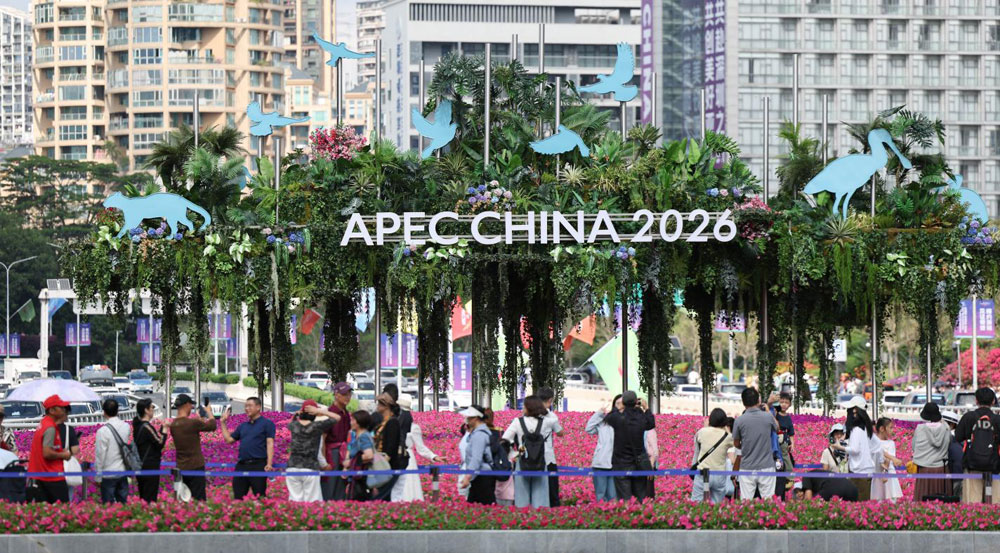
An APEC-themed installation is seen on Xiangmihu road in Shenzhen, south China's Guangdong Province, Nov. 15, 2026. The 33rd Asia-Pacific Economic Cooperation (APEC) Economic Leaders' Meeting will be held in Shenzhen from Nov. 18 to 19. The city has been adorned with flowers and lush greenery, with APEC elements integrated into the cityscape. (Xinhua/Deng Hua)
By Light Blade
This week, global business and political leaders are converging on Shenzhen for a pivotal moment in regional diplomacy. On November 17–18, the APEC CEO Summit 2026 will open at the Qianhai International Conference Center, setting the stage for the 33rd APEC Economic Leaders' Meeting on November 18–19. Marking China's third turn as APEC host—following Shanghai in 2001 and Beijing in 2014—and the most significant diplomatic event in the opening year of its 15th Five-Year Plan, the Shenzhen gathering arrives at a critical juncture. For a global economy weighed down by sluggish recovery and geopolitical fragmentation, the meeting offers a timely test of whether the Asia-Pacific can remain a pillar of stability and shared growth.
The central question facing the region is straightforward: where does Asia-Pacific cooperation go from here? Together, APEC's 21 member economies account for more than 60 percent of global GDP and nearly half of world trade, making the region the undisputed engine of global growth. Yet that engine faces growing headwinds—from rising unilateralism and protectionism to the increasing politicization of trade and industrial and supply chains. At such a moment, steering the region toward steady, open cooperation is essential. As the world’s second-largest economy, China contributes over 60 percent of Asia-Pacific economic growth and serves as the largest trading partner for 13 APEC member economies. By setting "Building an Asia-Pacific Community to Prosper Together" as the theme for the 2026 APEC "China Year," with "Openness, Innovation, Cooperation" as its three priorities, Beijing is making a clear case against decoupling and zero-sum rivalry.
Perhaps the clearest signal of confidence comes from the private sector, which has voted with its feet. More than 2,000 political and business leaders are attending the APEC CEO Summit 2026, with representation spanning all 21 APEC member economies alongside major enterprises from 13 non-APEC economies, including the United Kingdom, France, Germany, and Switzerland. Notably, 115 Fortune Global 500 companies are represented in Qianhai—with U.S. firms accounting for nearly 20 percent of participating enterprises from economies other than China, the largest international contingent. That level of turnout underscores a practical reality: multinational businesses still view the Asia-Pacific as indispensable, and they remain eager to tap into the opportunities of China's continued opening-up and industrial modernization.
Historically, this year’s summit also marks an important inflection point. Over the past quarter-century—from the 2001 Shanghai Accord to the 2014 Beijing Agenda and the Beijing Roadmap for APEC's Contribution to the Realization of the FTAAP, which formally launched the Free Trade Area of the Asia-Pacific (FTAAP) process—China’s role within APEC has evolved from participant to agenda-setter. Appropriately, 2026 marks both the 20th anniversary of the FTAAP vision and the final review year of the APEC Connectivity Blueprint for 2015–2025. Rather than settling for broad declarations, the Shenzhen agenda is geared toward concrete deliverables: the CEO Summit will issue the APEC CEO Summit Shenzhen Initiative 2026—the first initiative-format outcome document in its 30-year history—while leaders are set to advance practical frameworks on digital trade, cross-border data verification, an open and inclusive AI innovation ecosystem, and the digital and green transition, laying actionable groundwork toward the APEC Putrajaya Vision 2040.
Choosing Shenzhen as the host city carries unmistakable symbolism. Once a quiet coastal town, Shenzhen transformed into a global hub of technology and trade through China’s reform and opening-up—its rise mirroring the broader "Asia-Pacific miracle." Today, anchored by the Guangdong-Hong Kong-Macao Greater Bay Area's blend of world-class physical infrastructure and regulatory connectivity, the city serves as a natural bridge between China and the Pacific Rim. Giving international delegates firsthand exposure to Shenzhen's tech firms, green industrial parks, and urban dynamism allows the world to see China's innovation-driven growth up close—and turn dialogue into tangible, mutually beneficial partnerships.
Great eras demand broad vision and pragmatic leadership. As leaders gather in Shenzhen, the upcoming summit is both a reaffirmation of China's commitment to high-standard opening-up and a vital opportunity for APEC member economies to rebuild consensus. Guided by the forthcoming Shenzhen Declaration, the region has a chance to choose openness over barriers, innovation over stagnation, and cooperation over division—writing the next chapter of the Asia-Pacific growth story.

Tangerine harvest season underway in Xinyu City, China's Jiangxi
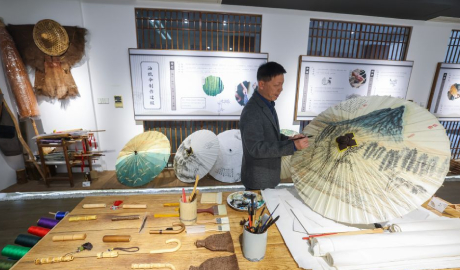
Umbrella industry thrives in Shangyu District of Shaoxing City, China's Zhejiang

Concert held in Malaysia to mark 160th birth anniversary of Sun Yat-sen

City music lounge starts trial operation in Hangzhou, China's Zhejiang

White swans from Siberian region of Russia arrive to winter at Yellow River wetland
点击右上角 微信好友
 朋友圈

请使用浏览器分享功能进行分享