


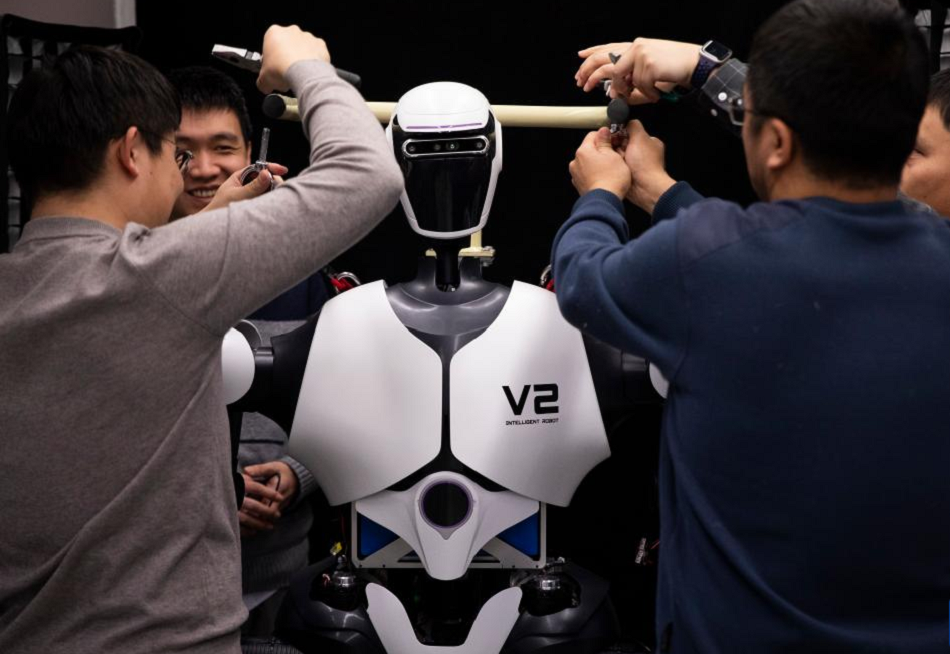
Photo taken on January 31, 2024, shows researchers from a humanoid robot research team debugging a robot at the State Key Laboratory of Multimodal Artificial Intelligence Systems. (Xinhua/Jin Liwang)
By Light Blade
On December 12 in Washington, the United States, Japan, South Korea, Singapore, the United Kingdom, Israel, and Australia signed the Pax Silica Declaration, seeking to build a “trusted supply chain partnership” spanning artificial intelligence, critical minerals, semiconductors, and other advanced technologies. The stated goal is to “protect the key materials and capabilities underpinning AI” and ensure that “like-minded countries” can develop and deploy transformative technologies at scale. Just weeks earlier, on November 24, the White House announced that President Donald Trump had signed an executive order launching the so-called “Genesis Initiative,” which aims to establish a nationally integrated AI platform to further consolidate US tech dominance and global strategic leadership—an effort described by officials as comparable in urgency and ambition to the "Manhattan Project".
The world is now in the midst of a new wave of scientific and industrial transformation. At its core is artificial intelligence, which is rapidly reshaping global economic structures and social institutions. Yet amid this historic technological shift, some countries have increasingly politicized and ideologized technology issues. In the AI domain, they have erected what critics describe as “small yards with high fences”—forming exclusive blocs, abusing export controls, and restricting investment and exchanges. These actions are widely seen as attempts to impede China and developing countries' advance in AI development. The result has been an artificially created “intelligence divide” and growing risks for the stability of global industrial and supply chains.
Explosive growth, shared opportunities—and shared risks
AI’s explosive trajectory is already reshaping the bedrock of modern society, from the way we innovate to the way we are governed. By revitalizing legacy industries, turbocharging scientific breakthroughs, and facilitating public services, AI is proving to be more than just a trend—it is a foundational shift. Much as the "Industrial Revolution" once unshackled human muscle, the AI era is unlocking human intellect, providing a vital new toolkit to confront global crises like climate change, pandemic prevention, and food insecurity.
Yet, history reminds us that technology is a perennial double-edged sword. Alongside its transformative potential, the unfettered expansion of AI carries a suite of profound, unpredictable risks. A recent IMF working paper, "The Global Impact of AI: Mind the Gap", sounds the alarm on a widening "digital divide": if AI becomes the exclusive domain of advanced economies, global income inequality could reach a breaking point. Projections suggest that growth gains in the developed world could more than double those of low-income nations. Lacking robust global governance and targeted technical aid, the developing world could face a "lost decade," marginalized by fragile digital infrastructure. Meanwhile, the more immediate threats of algorithmic bias and deepfakes are already proliferating—even as the long-term specter of losing control to super-intelligent systems hangs like the sword of Damocles over the future of our species.
These challenges transcend national borders. No country can insulate itself from or solve them on their own. AI governance affects the future of humanity, making cooperation a global imperative.

A visitors takes photos of the “Wukong” live-line operation robot at the China Southern Power Grid exhibition area during the 2025 World Artificial Intelligence Conference, east China's Shanghai, July 28, 2025. (Xinhua/Chen Haoming)
Resisting tech hegemony, defending digital sovereignty and equity
Regrettably, some nations have retreated into narrow-minded, self-serving protectionism. By weaponizing their early technological lead, they have manipulated public discourse, fueled disinformation, and deployed algorithms as tools of political interference to destabilize foreign societies and tilt elections. In this climate, AI is no longer viewed as a shared human breakthrough, but as an instrument of geopolitical dominance that erodes the very foundation of national sovereignty.
At the same time, under the pretext of “national security” and “values,” these countries have launched sweeping crackdowns on foreign tech firms—seeking to deny emerging markets and developing nations the right to climb the technological ladder. Such practices amount to what many describe as tech hegemony and digital colonialism.
Yet history shows that blockades rarely succeed. On December 1, Chinese AI company DeepSeek released two new models, DeepSeek-V3.2 and DeepSeek-V3.2-Speciale. V3.2 now reportedly ranks at the top among open-source models, while V3.2-Speciale outperformed GPT-5 across the board and surpassed Google’s most advanced Gemini 3 Pro on multiple reasoning benchmarks. Following the global shockwaves triggered earlier this year by DeepSeek-R1, the recent release has again drawn widespread attention.
The message is clear: technological progress is a collective achievement of human intelligence, not the private property of a few nations. The rise of Chinese innovators like DeepSeek demonstrates that innovation cannot be quarantined, and suppression cannot halt development. Instead, it only inspires greater self-reliance and independent advancement.
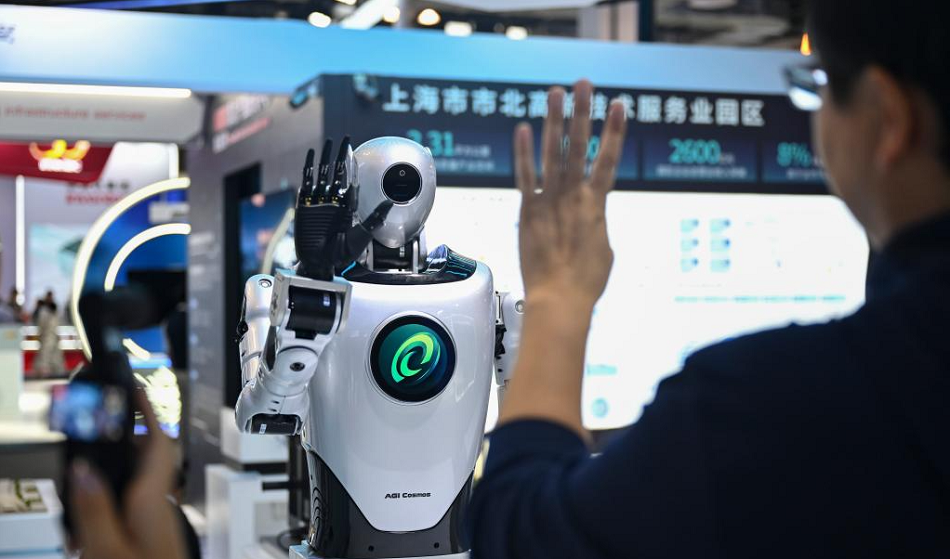
A visitor interacts with a humanoid robot at the 2025 World Artificial Intelligence Conference, east China's Shanghai, July 26, 2025. Designed for the healthcare and elderly care sector, the robot is capable of recognizing human body language. (Xinhua/Chen Haoming)
A multilateral path forward: China's proposal for AI governance
Amid growing uncertainty in global governance, China has positioned itself as a stabilizing force. Rather than responding to fragmentation with confrontation, Beijing has advanced what it describes as a pragmatic and forward-looking approach to AI governance. China has proposed the establishment of a "world artificial intelligence cooperation organization", reflecting its commitment to multilateralism in reforming global governance structures. The proposal calls for an inclusive, consensus-based governance framework under the United Nations, ensuring that all countries have equal participation in rule- and decision-making—rejecting exclusive clubs and unilateral dominance.
Crucially, the initiative responds directly to the concerns of the Global South. In July last year, the 78th UN General Assembly adopted—by consensus—a China-proposed resolution on strengthening international cooperation in AI capacity building, with support from over 140 countries. The resolution enshrines the principle of “AI for good” and places capacity building for developing countries at its core.
Building on this foundation, China has continued to push for concrete cooperation to narrow digital and intelligence divides. Through the "Belt and Road Initiative", it has supported digital infrastructure development in partner countries. Through platforms such as the proposed AI cooperation organization, China has pledged to share technological dividends, expand training and capacity-building, and ensure that AI benefits reach people across Asia, Africa, and Latin America.
The arc of history is bending toward a new reality: the AI era is no longer a distant prospect, but an irreversible reality. We find ourselves at a civilizational crossroads. Will we retreat into exclusive silos, weaponizing AI for a new age of dominance? Or will we embrace a spirit of openness, transforming this technology into a shared engine for human advancement? The success of firms like DeepSeek offers a compelling case for the latter, proving that collaboration is the true catalyst for discovery. Conversely, the “fortress” mentality currently taking hold in parts of the West serves as a stark cautionary tale: in the end, fences often serve only to confine the people who build them.
The path forward is best captured by a timeless Chinese proverb: "All things grow together without harming one another." In that spirit, China is calling for a global framework built on cooperation rather than conflict. If we can reject the zero-sum logic of the past and address the challenges surrounding AI as a collective, we can ensure the technology remains a force for good. The goal is no longer just about technical progress; it’s about ensuring that the AI revolution serves everyone, everywhere. It is time to move past the divisions and build a smarter, more inclusive world.
点击右上角 微信好友
微信好友
 朋友圈
朋友圈

请使用浏览器分享功能进行分享